Showing posts with label armbars. Show all posts

Sunday, September 21, 2014

Sticking a landing: Getting the most out of practice

I had the privilege today of working with a group of young people in a West Coast Judo Training Center practice held in Long Beach.

We did a lot of matwork drills and one of the points I tried to make is that there is little benefit in rushing through your matwork moves in a half-ass fashion. If you're doing your drills at less than full speed or less than perfectly, you are missing the point.

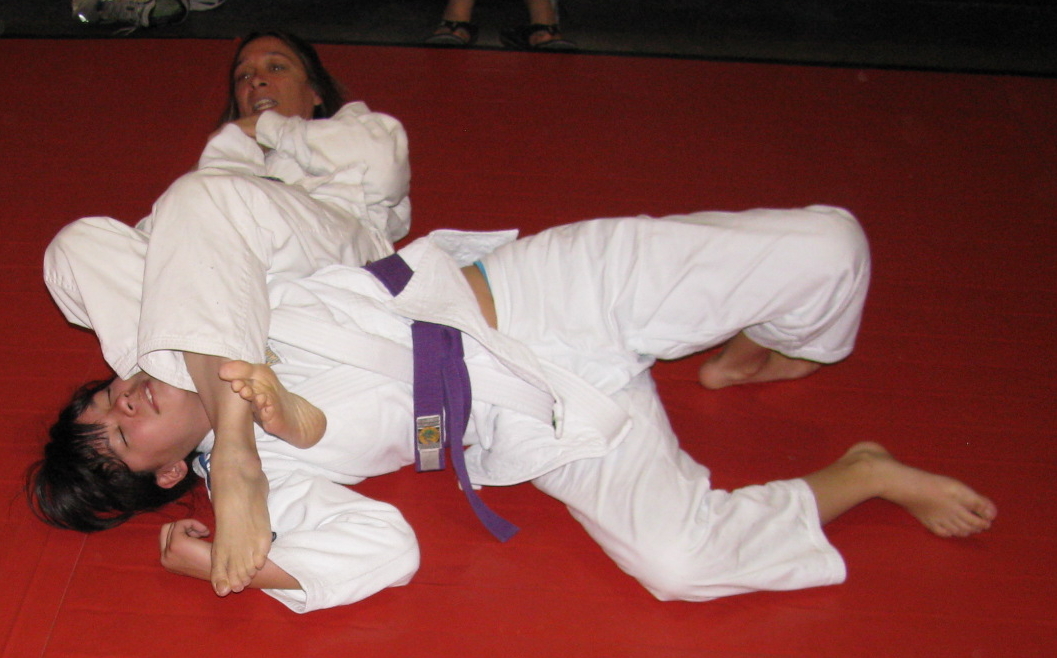
When I looked through this blog to find an example, I found a lot of them, which just goes to show that I practice what I preach. If you look at the picture above at the end of one of a zillion times I have done the same drill, my partner is flat on his back and I am pushing off on my toes to put all of my weight on him.

I do this EVERY time I do a drill.

Here is another picture with another person and another pin. Again, my body is on top of hers, my feet are under her hips, my hands are locked tight.
Here is yet another picture, on yet another day on yet another person. Notice that I have both hands on his arm, my hips are pretty much "sitting" on his shoulder, I have his arm locked against my chest.


I explain this as being similar to when a gymnast does a technique and "sticks the landing". After they flip off the bars, horse or whatever, they try to hit the ground and be as on balance as possible.

Now, when they are practicing, they could just kind of drop off the uneven bars or hop off the balance beam, but they don't because they are practicing to do it as they want to execute the move in competition and the landing is a key part. If they flip around on the bars, then dismount and fall over, they'll lose points and probably lose in the event.

The same with judo - if you do a turnover but don't really tighten up on the pin, or do an armbar and don't really have it locked in, then your opponent will probably get away.

Fast, hard and stick the landing. Do every one of your matwork repetitions that way every day. It's not just how much you practice that matters but how.

Sunday, September 22, 2013

Arm Bars and Lady Bits

My fellow coach was a bit embarrassed today when I explained to the students to get the right position for an arm bar, you should pretend that the opponent's elbow is your boyfriend (or girlfriend) as the case may be.

I'm not wearing a gi in this pictures so you can see the exact placement of the opponent's arm.

Once you have the arm locked in position, to break it, you make the exact same movement with your lady bits (or man parts, as the case may be) as if you really DID have your girl/boyfriend there. This will cause your opponent's elbow to bend in the opposite direction that God intended it to go and then all will be well - if we define all being well as the opponent tapping.

Now, every time I give this graphic description, people groan and say, "I can't believe you just said that."

However,  I noticed that while Blinky was saying, "Get your crotch on it more" people did not have the exact correct position, once I explained it, they understood much better.

(Kids aren't as naive as you think. Better tighten up those parental controls on the cable.)

------------------
Come to Kansas City for the AAU National Judo Championships and I will also be hanging out after weigh-ins on Friday from 6:30 - 8pm  teaching matwork. I will be slightly more socially appropriate, since there will be children present.

Also, buy the book Winning on the Ground, by me & Jim Pedro, Sr. It's good, and I'm not the only one who says so.

Also available for the Nook

Monday, February 18, 2013

Tomoe Nage Arm Bar- Hey, I didn't touch your leg

With the new rules in judo pretty much saying if you go near the person's leg while standing, we spent some time at practice today trying to figure out what is still legal. We went through several moves that Crystal, Erin and I happen to like and Oscar (Bradley's dad) took a video of all of the ones that we concluded were still legal.


Here is my favorite. You go into tomoe nage and when the opponent blocks you, throw your leg over and go into the arm bar.

Shameless plugs - you can find more cool stuff like this in the book from me & Jim Pedro, Sr. winning on the ground.

for the Kindle, here
the Nook, here or
Sony or other ereaders, here

You can get it in the iTunes store, too. And it comes out on paperback in March, those of you into dead tree media can order it in paper back from Black Belt here 

CHECK OUT THE GAME BELOW FROM MY COMPANY. IT'S AWESOME

Wednesday, November 28, 2012

There's more to an arm bar than an arm bar

Photo courtesy of Hans Gutknecht

Every time I read someone on an internet forum call Ronda a "one trick pony", I silently say a prayer of thanks that you can't catch stupidity through the internet.

Jim and I just finished writing an article on an arm bar as counter and combination. Here are three points we made.

First is that you should always practice both sides, so we showed the same move from two different angles and done on both the right side and the left.

The second is that an arm bar is not just an offensive move but a move in defense as well. The arm bar Ronda is doing here is in the MIDDLE of the sequence. It is a counter to a move Manny attempted.

The third is that an arm bar isn't necessarily the end. It can also be part of a combination. The photo below is a pin that is done after your partner escapes the arm bar by doing a forward roll.


There is another pin after this, too.

The point we make in the article is that an arm bar is not an isolated move. If you really are an expert, you can do it from both sides, multiple positions and multiple points in a sequence, at the beginning, at the end or, as shown here, in the middle. It is not just a finishing move. That is particularly so in judo where you can win by a pin just as easily as an arm bar. In fact, more easily. (Remind me to explain that some time.)

Jim says this same move works in wrestling as well, that even though arm bars are not legal you are allowed to put pressure on the arm and when the person rolls over you can pin him and win the match. I don't know as much about wrestling as he does but he sounded very believable when he said it, so I am going  to believe it.

Wednesday, November 7, 2012

How you,too, can be awesome at matwork

The lesson for today is that Ronda is awesome at matwork and I am awesome at teaching it and how you can be awesome, too.

While we were walking down to vote this morning, we were discussing my recent blog on doing matwork to the opposite side. Ronda objected,

"What do you mean opposite side? There are no sides in matwork! You taught me that ever since I was a kid."

I agreed with her noting that she had armbarred Miesha Tate's left arm.

But that she had armbarred Sara Kaufman's right arm

Ronda laughed and said,

"That's because I'm so awesome and you must be an awesome teacher because you taught me to always, always practice both right and left. You had me do everything to both sides and so now I'm always ready to catch whatever is there, which is why sometimes I get their right arm and sometimes the left."

All you people who call her a one-trick pony, hey, there are at least two tricks right there!

As I mentioned, when I was doing the opposite side day, I found it was NOT equal for me, I had to think a half-second longer on the left side. It occurred to me that since I have not been competing for a long time, or even doing that much other than teaching, I have gotten into the habit of always demonstrating on the right side. If I am demonstrating a drill and show doing ten of a technique in a minute, I do all ten on the right side.

My point, which you by now have despaired of me actually having, is that no matter how old and experienced you get, you need to constantly evaluate yourself. Even if you have good habits from the start, it is easy to get lazy or forgetful and fall into an easy rut if you are not evaluating yourself.

Why bother? It's not like I'm going to be competing again in this lifetime. One reason is because as an instructor you are a role model. If you only practice one-sided, only demonstrate one-sided, that's what your students will do. A second reason is that you don't want to get in so much of a rut that you forget.

Those people who say,
"I've forgotten more judo than you'll ever know!"

Well, that's bad that they've forgotten it. Don't be them. Be awesome.
From now on, I'm going to make a conscious effort every practice to demonstrate and drill techniques to both sides.

So .... what have you forgotten that you used to know? I'm working on a list to post tomorrow. Ideas welcome.


Friday, July 6, 2012

Like this, not like that: Wake gatame arm bar

Looking at pictures for a draft of the book - obviously not everything will make it in the book. I saw this photo and it just made me cringe. I think this was an out-take

for two reasons. First, because just looking at that right arm straight like that makes me think of dislocated elbows, even if just by accident. If the player on the bottom hits Hana's right elbow with her knee trying to move out of the position, that elbow is going to go.

I also thought it was a mistake because shortly after it in the photos Riley sent me was this:
In the second photo, you can see that her right arm is bent and she is leaning her weight on her elbow. 
I *think* though I am not sure, because this is a part Jim wrote and I haven't talked to him about it yet, that putting your weight on your arm at all is something you do in the drill to prevent your opponent from being face-planted into the mat as you do a wake gatame. 

In competition, though, I would think you would not put your arm there to slow yourself down and it would be, 

"Face, say hello to mat."


Monday, May 7, 2012

Apparently, it doesn't bother you to lose

About a year after I won the world championships, I was out drinking margaritas with Bruce Toups, who, at the time, was the Director of Development for judo in the U.S. If you have never met Bruce, you've missed out on one of the more brilliant analytical minds when it comes to dissecting what it takes to win a judo match. 

He said,

I've watched a lot of judo players over the years, a lot of people I thought had talent. I was trying to figure out why you were the one that won the gold medal. So, I watched every one of your matches that I could find on tape. Here is what I noticed. I saw matches where you lost - I didn't see very many of them - but YOU NEVER LOST THE SAME WAY TWICE.

I remember this (although being nearly 30 years ago, I cannot swear this was verbatim what he said) because it struck me at the time such an odd thing to consider worthy of comment. Of course I never lost the same way twice! I HATE LOSING !!!  Any time I would lose, I'd go back to the dojo and work and work and work on whatever it was so that never happened to me again.

If someone choked me, I would find whoever in the area did that same choke and work out with that person every single round that I could until I could stop it 100% of the time. I'd teach that choke to everyone in my club so that they could try it on me. If I was working with someone who was less experienced or smaller, I'd let him get me in that choke, so I could fight my way out of it. 

At the time, I had just finished competing and had not yet started coaching, so I still had that tunnel vision where I assumed everyone was just like me.

Over the years, I have found that no, not everyone hates losing so much that it eats at them. No, not everyone goes back and works on whatever they lost by. In fact, lots of people go home, say they were unlucky, the referee made a mistake, the other guy got to train in Europe and they didn't or whatever the reason - and then they lose the exact same way next year.

I was working on our book, Winning on the Ground, and Jim had included a move I have seen his son do 100 times, Ronda do 100 times, Aaron Kunihiro do 100 times and so on. My initial reaction was, "Oh God, do we really want to include that? I have seen it SO many times!" But I thought about it for a second and realized that yes, we really do want to include it, for two reasons. First, it is a signature Pedro move and as my friend, Steve Scott says, if he picks up a book by someone famous for a certain thing - whether it is a golf swing in a golf book or an arm bar in a matwork book - he expects to see that thing in there. It's one of the reasons he buys their book. The second reason, though, is that after all of those hundreds of people who have lost to this arm bar, it still works. In part that is because there are always new people coming up. It may be an old move but it's new and amazing to them. 

The other part, though, is that lots and lots of people lose the same way twice. I guess it just doesn't bother them that much. 

This still puzzles me. 

Sunday, April 15, 2012

Throw, Pin, Armbar

Most of my life now is spent running statistical analyses for clients or working on our latest product. However, I took out a couple of hours to go over to Gompers Middle School and teach judo. As you can see from the pictures, the students are coming along nicely.

I am always harping on thinking about your mat work from the very beginning. In particular, I'm always saying that your mat work begins from the time you get a grip. Here is another example from my wonderful students at Gompers Middle School. 

Step 1: He starts standing and does a one-armed shoulder throw. His partner blocks it. Notice where his left hand is in this picture.

Step 2: Unable to get his opponent with the first attempt, he drops to both knees for a double knee  shoulder throw. 

Step 3: He completes the throw and immediately .... goes to 

Step 4: A kesa gatame (scarf hold) pin. Note where his left hand is in this picture. Did you notice that is in the EXACT same place as in Step 1? He has a grip on her right arm and he also has it trapped under his arm pit. Now notice where his right arm is in THIS picture.


Step 5: If she pulls her arm down from his arm pit and it is straight, he is going to hook at the wrist with his left leg and arch his hips to apply the arm bar. 


Step 6: If she pulls away from the first arm bar, bending her arm to keep him from arm barring it, he is going to hook her arm with his right leg. He just needs to lean forward a little to bend her elbow at an unnatural angle and have her tapping.

I wanted to point out where his arms were in this move because it illustrates an obvious point I see people forget in mat work all of the time. That is, don't let go of what you have until you have something else. 

A second important point is - don't stop. Notice how this move goes from one throw, to another throw, to a pin, to an arm bar to another arm bar. 

For people who have asked about how well judo translates to mixed martial arts - well, to be honest, some techniques do and others, not so much. This particular technique, you could do exactly the same without a gi. You would just grab the opponent's arm instead of the jacket.


Wednesday, March 28, 2012

How to do an arm bar right: A rant


It’s getting into the position to do an arm bar that is the hard part, and takes up a good many pages on this blog and in our upcoming book. My friend, Steve Scott, has written two books JUST on arm lock, as well as The Tap Out Textbook and Gene Lebell has a ton in his Encyclopedia of Finishing Holds .

The actual physical activity of doing an arm lock is pretty simple.  Here is one simple way to do a straight arm lock.


Step 1: You begin with your partner on his or her back. You have hooked the opponent’s arm and have it locked against your body. You have both your legs across the opponent’s body as shown. Usually, feeling in danger, your opponent is going to have gripped both hands together and be hanging on to that arm for dear life. Lock the opponent’s arm against your chest, holding it tight to your body. Rotate toward the opponent’s head to break the grip.


Step 2: Once you have the arm pulled free, rotate back to be pulling the arm straight out from the shoulder. (If you were good at geometry, you will remember that is forming a 90 degree angle with the body.)


Step 3: With the arm locked against your body, arch your hips to complaint the arm bar.


That holding it tight against your body is a really important point. If you grab your opponent's arm with both hands and she grabs her own arm then you are going with your two arms against her two arms. The stronger person will win. 

Instead, if you lock her arm tight against your chest and rotate back towards her head, her arm is at an angle. All you need to do is hold on, lean back toward the mat and let gravity do the rest. She is going to have hold up your body weight. 

Try this exercise. Lie on your back and put your arms at an awkward angle over your head. Clasp a 100-pound dumbbell between your hands and hold it six inches off the floor. See how long before your arms give out.  This explains why smaller players, if done effectively, can apply an arm bar to a much larger player, the opponent is being put in the position of having to hold up a substantial amount of weight with her arms at an uncomfortable angle.


Let me pause here to rant and complain. I am ALWAYS hearing people correct judo players, grapplers, MMA fighters in how they do an arm bar.

Most of the corrections, though, I am skeptical. I always hear people say you need to pinch your knees together, don't cross your ankles, you always need to lock the arm against your body with both hands, grab the wrist instead of the gi , turn the arm so the little finger is pointing up (or down).

In many, many pictures where I, Ronda or someone else is doing an arm bar some black belt, instructor or just random person walking around will point out,
"That isn't right."
In writing The Book, I've had many, many people take pictures of arm bars being done in practice, in competition and had almost as many comments from almost as many people on what is wrong with the technique.

All of those people are correct. I have heard the same things as them - your knees need to be pinched together, the arm should be locked against your body - I've even made some of those same comments.

Here's the thing  - IN EVERY SINGLE ONE OF THOSE PICTURES SOMEONE WAS BEING ARM BARRED.

This has led me to conclude that if all of those people who are doing arm bars in practice and competition are doing them "the wrong way" maybe there isn't just one right way after all.


Tuesday, March 27, 2012

Half-nelson to a sneaky arm bar

I'm amused by those people who say that Ronda will be easy to beat because "all she does is an armbar". In basketball, all anyone on the team wants to do is throw the ball through the other team's hoop and yet somehow, between the two teams, they manage to get hundreds of points each game, time after time. How is that even possible?

The obvious answer in both cases, of course, is that there are an almost infinite number of ways to come at it.

Let's begin from where we were yesterday, with the sneaky arm bar drill, but with an opponent who is not quite as defensive.

SNEAKY ARM BAR DRILL: PLAN B

Step 1: My opponent starts out on her base, with her legs spread apart, on her knees and her arms pulled in tight, but not as much in a ball as in the first step in the previous technique. When I pull her toward me and try to roll her, she puts the arm nearest me - her right arm - out to stop me from turning here.


Step 2: Here I am doing a half-nelson wrong. I have my right arm under her right arm. I have my left arm over her back, shoving her elbow forward trying to keep her from posting with that arm to stop the half-nelson. I have my left leg bent, with my knee up against her body and my right leg straight, driving my weight on her. I am going to try to walk around her head and pin her.

Step 3: To stop herself from being turned over, she is going to have to do something with that left arm. In this case she happened to push back so hard with her elbow that when I quit pushing her arm and let go her left arm ended up almost straight, palm up. The specific position doesn’t matter so much. My whole intent in the half-nelson was never to turn her over but to provoke a reaction from her. As soon as she moves the left arm out, notice how my left hand was there, ready to slip under her arm and grab it. At the same time, I have stepped forward with my right leg, to the other side of her head.

Step 4: As I stand up, I pull her arm against my chest. My right hand, which was on her head, comes up to grab her arm, too. My right leg is across her body and I am practically sitting on her shoulder.

Step 5: I throw myself backward, and as I fall my left leg comes forward over her body.  You need to move that leg as you are falling backwards to avoid having it trapped under the opponent’s body.


 Step 6:
Here is how it ends again, with his arm locked against me, knees tight and me arching my hips to execute the arm bar.

After a while, when I am teaching, someone is bound to ask -

"All of this is set up to get the person to resist by putting an arm out, but what if they DON'T? What if they have caught on to you? That must happen eventually, right?"

That is right, and it absolutely does happen. In that case, if the person does not put an arm out, he or she ends up pinned. The reason that the way I did the half-nelson above is wrong is that anyone can stop it easily by posting out with that left arm. If the opponent doesn't do that, then I end up getting the pin. The same is true for the turnover I discussed previously.

The more of a reputation I got for arm bars, the more people I pinned. Because my opponents were so intent on holding their arms in tight to keep from being arm barred, they weren't able to defend against pins effectively.

That IS sneaky, isn't it?


More than one way to get an arm bar: With pictures

This is what I call the Sneaky Armbar Drill. Since I made it up, that is the name.

Continuing from my previous post, here is one way to get an arm bar even when your opponent is deliberately avoiding being arm barred.

Step 1: If you have arm barred a lot of people, your partner may react on the mat by getting into a turtle position, pulling her arms in tight. Push down on her head and reach as far as you can between her legs. Grab her belt, or bottom of her jacket. When doing this on a partner without a gi, grab the inside of the leg.

Step 2: Pull the head toward you, while pulling up on the partner’s belt, gi or leg.

Step 3: The opponent feels confident he can stop this turnover attempt, all he needs to do is get a more solid base by spreading his legs a little further and putting an arm out to stop it, as shown above.

Step 4: Notice how close my hand was to that arm ... when the opponent makes even a few inches of space, my hand slides right under his arm. At the same time, my near leg is coming up so that he is blocked turning in one direction by the leg against his head. My other leg, on his opposite side, blocks him from moving in the other direction. Notice something else, my body is on his back just a few inches from his arm.

Step 5: I grab the opponent’s wrist with my other hand while sliding up the hand hooking the arm so I have two hands grabbing the wrist. I am about to lock his arm against my chest, which is just a few inches away.


Step 6: I throw myself backward, keeping a tight hold of the arm with both hands. Note that the picture above was taken AS I WAS FALLING and both legs are already coming together with his arm between them. My right leg was in the correct position from the time I stepped over in the previous picture. Since his arm is locked against my body, as I fall backward, his arm is going to come straight.


 Step 7: Here is how it ends, with his arm locked against me, knees tight and me arching my hips to execute the arm bar.

A very polite young man at Hayastan Martial Arts, where I was visiting tonight, asked me, 

"But Sensei, realistically, if you were doing this in a match wouldn't he grab his other arm and stop you from arm barring him?"

That is a good question but the answer is, "No". There are three reasons. 

First,  he is not thinking about being arm barred at the moment. He isn't feeling threatened at all. He's just thinking this isn't a very strong turnover attempt and is feeling confident he can get out of it easily, just by putting an arm out to stop it. I'm ready and waiting for the arm bar attempt and the opponent is not.

Second, I have the advantage not just of surprise but of distance. My hand is closer to his arm than his other arm is. At Step 3, when the opponent posts an arm, my hand will be about four times closer to that arm than the opponent's other hand is AND I know I'm going for that arm and my opponent doesn't. That's a pretty big advantage to overcome.

Third, I am moving my hand and leg simultaneously and the SECOND that I get that arm, I am pulling it even further away from the opponent's other hand, with my foot on one side of the head and my knee on the other side of the opponent's body slowing resistance.

All of this relies on the opponent putting that arm out just at the right instant doesn't it? Well, yes and no. This particular move relies on putting that arm out just at that time, but the next few posts will discuss what to happen if he doesn't and how to make sure he does.

It is all very sneaky.


Thank you very much to Dan McNair for taking the pictures, and to Adam Sanchez of Barstow Judo and Eileen McNair of San Gabriel Judo for being my victims, um, opponents.

Thursday, March 22, 2012

There is more than one way to get an arm bar - or write a book

Jim Pedro, Sr. and I have an actual contract with Black Belt Magazine to finish The Book by mid-July, so I have been working on it pretty regularly. The latest chapter has several matwork combinations, about equally divided between ending in an arm bar, pin or choke. Jim wrote that chapter so I am editing it and putting the finishing touches on it.

 A couple of weeks ago, after Ronda's fight we had a small party for family and friends and the inimitable Dr. Rhadi Ferguson, a teammate of Ronda's on the 2004 Olympic Team, stopped by. He asked how the book was going and what it was like having Jim Pedro, Sr. as a co-author.

I get asked that question a lot. I guess we are an odd couple to be co-authors. Jim is a retired firefighter. I have a Ph.D. and run a company that specializes in statistical consulting and customized software.

Jim travels all over the world coaching elite athletes to the point that judo has pretty much taken over his whole life. I still have a child in middle school, a business and I teach twice a week, once at a middle school in south Los Angeles and once with up and coming young athletes at the West Coast Judo Training Center.  If I'm traveling it is more than likely to give a talk on different model fit statistics in logistic regression.

I told Rhadi,

"It's great, but if you read the book, it is the opposite of what you would think. All of the really cerebral, analytical parts were written by Jim and all the parts that sound like they were written by an ogre  - Bash him down, break arm - were written by me."

There is a reason for that, going back to the points above. Most of my judo has been designed around two people, me and my daughter, Ronda. I read a wonderful line once,

"Every elite athlete is an experiment of one. They are outliers on the distribution of humanity."

Jim has to develop techniques for a wide range  of athletes at the elite level, while I only needed to come up with what would work for local and regional level players, for me, and later, for Ronda. Some techniques do work at all levels. The o soto gari (outside leg sweep) that Ronda used to win her first tournament at 11 years old, also won her matches at the world level in both judo and mixed martial arts.

There are also techniques that work better for some types of athletes than others. I wrote about the role of strength in judo competition a while back and the fact that my techniques tend to rely on strength more than those Jim teaches, which is kind of opposite of what you would expect, given that he is a big, hairy, scary body-builder looking type of guy and I am just the perfect size to be shipped in a box.

Let me give you an example of a technique that I would do --

Step 1: The opponent is on her hands and knees. Either she attempted a throw and missed or I attempted a throw and only succeeded in knocking her to her knees.  If she hangs on, I am going to "help her up" -  a move I cannot believe I did not show on here previously but I can't see that I did - where I slam her to the mat. Since she is not stupid, she let go.

Step 2: I am going to reach between her legs and grab her belt or as high up on the jacket of her judo gi as I can get. I'm going to pull up with her belt and push her head down at the same time, trying to literally roll her head over heels.

Step 3: This is a really stupid move. Almost anyone can stop it by putting an arm out to post.

Step 4: When she does that, I am going to catch the arm she puts out to stop herself and arm bar it. (Didn't see that coming, did you?)

And THAT, my dear, is how I managed to arm bar dozens of people even when they knew to look out for the arm bar.


P.S. One of you people at the training center remind me to teach that and take pictures this weekend. Also, the help 'em up move.


Saturday, March 17, 2012

What does judo have against arm bars?


There has been a lot of talk lately about arm bars and judo, in part, I think, because Ronda has been taking arms like there was a bounty on them. Two of the dirty little secrets we judo people don't like to air in public are:

  • Most judo players are not very good mat work
  • Particularly in America, most judo players are not very good at mat work

It's considered not as "good" to win on the mat as by throwing someone. I've had lots of people say "AnnMaria's judo isn't very good. All she did was win on the mat."

Yes, I'm not very good, all I did was win a world championship and some other random stuff. Someone criticizing the way I competed once said to me,
"I've never seen you throw with uchi mata or tai o toshi in your life. THAT's real judo. What do you call that rolling around on the ground you do?"
I answered,
"I call it winning, asshole."
 The fact that there wasn't one is not the ONLY reason I did not win the Miss Congeniality award of the judo team.

Most clubs don't spend nearly as much time on mat work as they do on standing techniques with the result that they aren't nearly as good at it. I've written a lot of posts on this, including this one, Matwork Bottom Line: You do too few techniques and you're too slow. 

Not only are most judo players not particularly good at mat work but they really suck at arm bars. The reason is that Americans aren't even allowed to do arm bars in competition until they are seventeen years old and a brown belt. In some local and regional tournaments, you can't do arm bars until you are a black belt. I've even been to tournaments where arm bars are not allowed, period.

I once was visiting a very large, well-respected judo club and they asked me to teach but said,
"Please don't do arm bars. We don't want to scare anyone away."

I taught a roll over choke. Later, the instructor told me they would prefer I not teach dangerous techniques to their white and green belt ADULTS!  He was very nice about it, I must say.

I've asked many judo instructors and tournament directors why we do not allow kids in judo to do arm bars. They say because it is dangerous, kids don't have enough control, we could get sued. Of course, jiu-jitsu allows arm bars for very young kids. Other countries allow kids in judo to do arm bars.

Ignoring all of this, I have taught arm bars to kids for years.


No one has ever gotten injured at any practice from an arm bar. Of course they have not gotten injured in tournaments because they have not been allowed to do them.

My point is that if you are planning on taking up judo to learn arm bars, do a little research on the judo club before joining and see if that is something they even encourage.

Caveat emptor.

Personally, if you live in Los Angeles, I'd recommend two places where you could get better arm bars. It is not that these are the only clubs teaching arm bars but I'd say they are both known particularly for their joint locks.

One is Hayastan Martial Arts and the other is from  Richard Elizalde. 


Friday, February 17, 2012

Sneaky armbar entry

Previously here, on many occasions, I covered the "Collect the Arm" move. I also talked about the Lego Theory of Judo where everything connects to everything else. Moving on ....  let's put these two ideas together.

This guy makes the mistake of knocking me down. Generally at this point the person moves in and tries to pin you. If he doesn't, I'm going to pull him in anyway.
I'm going to "collect his arm", by hooking over his arm above the elbow and reaching across to take a grip on the far lapel. Ronda demonstrated the turn over from here in a previous blog. Click here if you don't remember it. (What? You didn't memorize my blog? What's wrong with you?)
So, I have done the turnover and now I am on top. I am going to pull up with right arm, the one I had "collected" in the previous post. I may be able to put pressure on his elbow here and make him give up. Sometimes they do, but more often not. What they DO, though, is try to use that other arm to try to push me away.


If you have one arm caught at the elbow and you are pulling up on it, you're on top of a person and your opponent has the other arm free, he is naturally going to use that arm to try to push you off the arm you are applying pressure on.  When he does, I am going to lean forward, grab the *other* arm that he is pushing with, lock it against my body and step across his head, letting go of the arm I had a minute ago.
Notice how when I step across with my right leg, I come up off the floor.

My left leg is already on the other side of his body. All I need to do at this point is hold the arm locked against my body and arch.


Make a note of this, I'm *NOT* going to let go of the arm I had first if the arm bar is working. That would be stupid. However, the fact is that I often don't get the first arm bar attempt. Once I have rolled the person over and I have their arm trapped, they're suspicious, trying to pull in that arm. They aren't thinking so much about the arm that I don't have.

That's why it's called the sneaky arm bar entry.


Sunday, January 22, 2012

The Juji Gatame Encyclopedia


This is the foreword, I wrote for Steve Scott's upcoming book, The Juji Gatame Encyclopedia

When I was young, two-time Olympian Pat Burris gave me this advice,

“Always go for the arm bar, because even if the referee doesn’t give you the win and makes you stand up again, for the rest of the match, you’re fighting an opponent with one working arm. And, Annie, if you can’t beat a one-armed opponent, you really suck.”

(Just so you know, you have to be in two Olympics and older than me to call me “Annie”. Don’t even think about it.)

I took Pat’s advice to heart, as anyone knows who saw me on TV winning the Panamerican Games. The referees did not stop the match and made us get back to standing. Just as Pat predicted, my opponent was hampered by an injured arm and I won the match.

Enough about me (and Pat), what about Steve’s book? It is pure and simple everything you need to know about  arm bars. The section on exercises specifically designed to build muscles used in arm locks is just brilliant. Not only is it a good, safe way to teach beginners some skills, it’s also good for any athlete who was ever injured - and all top athletes are injured at some point - to have something they can do to build strength when they are not cleared for grappling.

My favorite part of the book, though, is the drills. To get good at arm locks you need to do tens of thousands of repetitions. Think about it for a moment, when you are trying a move that has the potential to dislocate an opponent’s arm, you are fighting a motivated individual. Often, there is just one second to catch that arm and to be able to capitalize on that one second you need to have drilled and drilled so it is almost an instinctive reflex. Let’s be honest, though, repetitions can get boring and no amount of a coach yelling, “No pain, no gain” at you can change that fact. Having a huge variety of drills and exercises allows athletes to train from different angles, at different speeds and for different situations.


Anyone reading this book will benefit from the photos showing the techniques from every angle. If you don’t learn how to do a better arm bar from this, you’re beyond hope.

Wednesday, November 16, 2011

She calls it MMA now

Earlier this week, a judo coach I had not spoken to in a couple of years caught up with me on Twitter and said,
"I just heard that Ronda is a professional fighter in MMA. So, is she not doing judo at all any more?"

I responded,
"She's still doing judo. She just calls it mixed martial arts now and gets paid for it."

Now is the time in every fight when I call up Jim and say how worried I am that my little baby is going to get in a ring with people who are going to try to punch and kick her. Jim always says the same thing, that she'll be fine, that once they clench up, Ronda will throw the woman and arm bar her because it is what Ronda has been doing since she learned arm bars in the eighth grade. I pointed out that is what the other person would expect and that in the pre-fight interviews her opponent said they had been training for that. His answer,
Yeah, well what did you expect her to say to reporters? 'I think I'm going to get killed?'
Even though I think I will never get over worrying about all of my kids, I have to admit that Jim does have a point. Ronda won the high school nationals by arm bar when she was a freshman, before she was even old enough to be allowed to do them in the USJF Junior Nationals. She won the women's division of the California state championships with an arm bar the same year. When she was 16, she was winning matches in the Ontario Open with arm bars, beating the then-Panamerican champion.  At 17, she was winning matches in the Junior World Championships with an armbar, on her way to taking home a gold medal. She was the first American woman in a decade to win a World Cup, including a win with an armbar that made it into 101 Ippons.

So, yeah, however much practice that other woman has in avoiding arm bars, I'd be willing to bet that Ronda has a lot more experience getting them on people who don't want to be gotten, and who have practiced their defense a lot, specifically defense against her. Just like in the 2004 Olympic Trials, my money is on the little pumpkin.


Tuesday, August 30, 2011

Even Better Armbars & the Necessity of Coaches

A month ago, I sent Jim Pedro, Sr. the final draft of one THE BOOK chapters on matwork. He called me up and said,

"The picture of that armbar is all wrong."
I said, "What are you talking about? That is exactly what he is supposed to be doing. First, he locks the arm tight against his body, which is exactly what he should do. Next, he rotates toward the head, forcing his opponent to resist at an angle, rather than being able to just do a curl to get his arm back.

Now, he's got both hands on his one arm. He has the arm flat against his chest. He has it perfect.
Jimmy objected,
"Yes, but look at his legs in both of those pictures!"

He was right. I (and Karo and Rob in the photos above) was focused on showing how you need to lock the arm against your body and you need to rotate toward the head and you need  to lift with your hips to finish. Once it is pointed out, if you look up above to the first photo, it is obvious that his legs are really wide apart and so he does not have his opponent nearly as tight as he could.

In the photo below, Roman shows a better armbar on Manny. Notice how much closer together his legs are. Remember all of those leg curls you did in the gym? (You didn't? What?! Well, you should have!) With Roman pulling Manny in with his legs like this he has that much extra strength to hold the armbar, strength that has gone to waste if you do the armbar like in the first two photos.
Here's another variation Roman does which I kind of like where he does a figure 4 on the arm. I never really did it that way when I was competing because my knees didn't really work. This armbar looks cooler and it looks like it would hold the person from getting away, but, personally, I like the one just above, I feel like I'm using my leg strength to pull my opponent in tighter for the armbar.

I thought this discussion brought up an interesting point. Rob, Karo and I are all black belts. We all know armbars fairly well. Yet, when we did those first two photos we were talking about and thinking about locking the arm against your upper body, breaking the arm away from the opponent's body and finishing the armbar. It isn't that Karo (or I) didn't know that your legs should be tighter together, we just weren't thinking about it at the moment.

When I explained to Roman and Manny that I needed to re-take the photos they knew exactly what I was talking about and we took those shots right away.

I got to thinking about the importance of a coach, of someone who is NOT thinking of exactly what you are thinking about at the moment and who can spot those mistakes that really are obvious once they are pointed out to you. The more I thought about it, the more convinced I became that to be successful at an international level, you really need a coach. You cannot do it yourself. Certainly you can win local and regional tournaments coaching yourself, and plenty of people do. Possibly you can even win the nationals in the U.S. without a coach. As you get to an international level, though, the differences between the top players in conditioning, in natural physical ability, get smaller and smaller. At that point, I think having a good coach who can spot all of those little nuances can really make a difference for you.

My criteria for a good coach differs from a lot of other people in this country. That's a topic for another post but I will tell you this, the main defining factor for me in whether someone is a good coach for me is whether I'm getting better and whether I'm getting the results I want. I see people who train in the same place for years, telling me their goal is to make an Olympic team and they've never come any closer than making the top three or five in the U.S. If that is you then there are three possibilities,
  1. You don't have the necessary talent.
  2. You aren't working as hard as you could.
  3. This coaching situation is not working for you.
I suppose there are others - God hates you, you were cursed by a gypsy for breaking her favorite crystal ball, but personally, I'm going with those three.

As I said though, that's a post for another day.